What temperature to set the heat in a Delaware winter

One request and finding someone for the tune-up is handled.

Step 1 of 3: Equipment

What should I set my thermostat to in winter in Delaware?

You want a number that works for a Delaware winter without running up the gas bill or leaving the house cold. With power rates high here, it helps to know what's actually reasonable to set the furnace to, and whether turning it down at night or while you're out is worth the trouble.

68 degrees while you're home, lower while you're out or asleep

68 degrees is the standard setting for most households during the day. Each degree lower cuts into your heating costs, since the furnace runs less to make up the difference between the air outside and the air inside. Dropping to 60 or 62 at night or when the house is empty for a few hours saves more, and your furnace can recover the few degrees in a reasonable amount of time once someone's back or the thermostat kicks it up again. Since most homes in Delaware heat with gas, this setting controls the furnace's runtime directly, not just comfort. If a room still feels cold at 68, that's usually a sign something else needs a look, not a reason to push the thermostat higher.

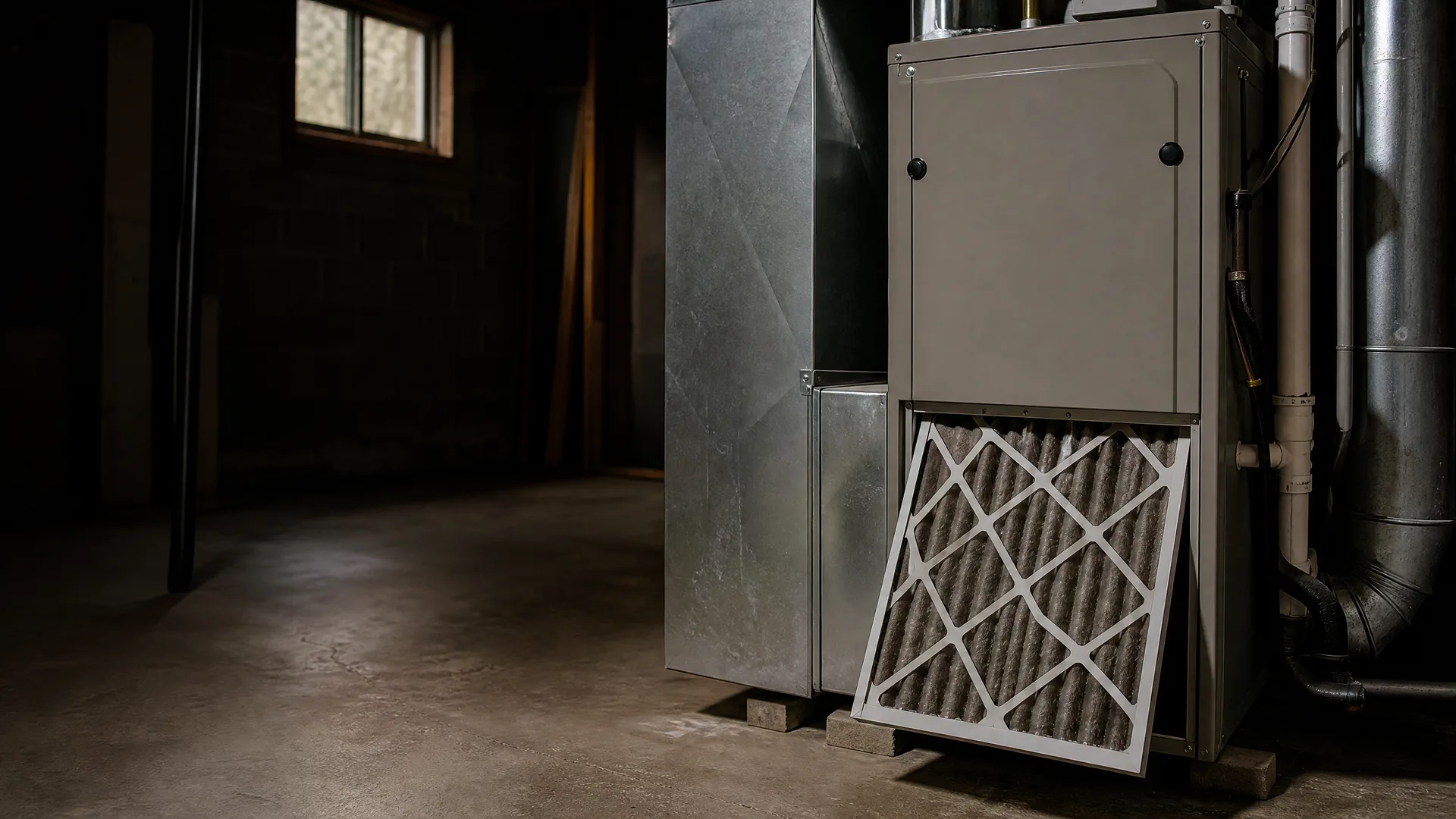
A gray furnace with sheet-metal ductwork in a dim basement, with a dirty pleated air filter leaning against its base on a concrete floor.

You pull the filter half out and stop. It's October, and you'd meant to check it before the cold really set in. The furnace has been cycling on more these last few weeks as Delaware mornings turn sharp, and the filter shows it, grey and matted with a winter's worth of dust it hasn't even seen yet. You hold it up to the bare bulb and can't see light through it. Behind it, the burners tick over, pulling harder than they should to push air through. You think about the thermostat set at 68, a number you picked because it seemed fair, and wonder how much of that heat is actually getting upstairs, and how much the furnace is spending just to breathe through this.

Why does one room never feel as warm as the rest?

You set the thermostat and it holds steady, but the back bedroom still feels cooler than the hallway. Maybe the furnace runs longer than it used to before it shuts off, or you hear it kick on again sooner than you'd expect for the setting you picked. You might notice a burning smell the first few times it fires up in October, or the air coming from the vents feels weaker than last winter. On its own, none of that means much. Left alone through a full Delaware winter, a furnace working harder than it needs to wears down faster, and the parts most likely to fail do it on the coldest night, not a mild one.

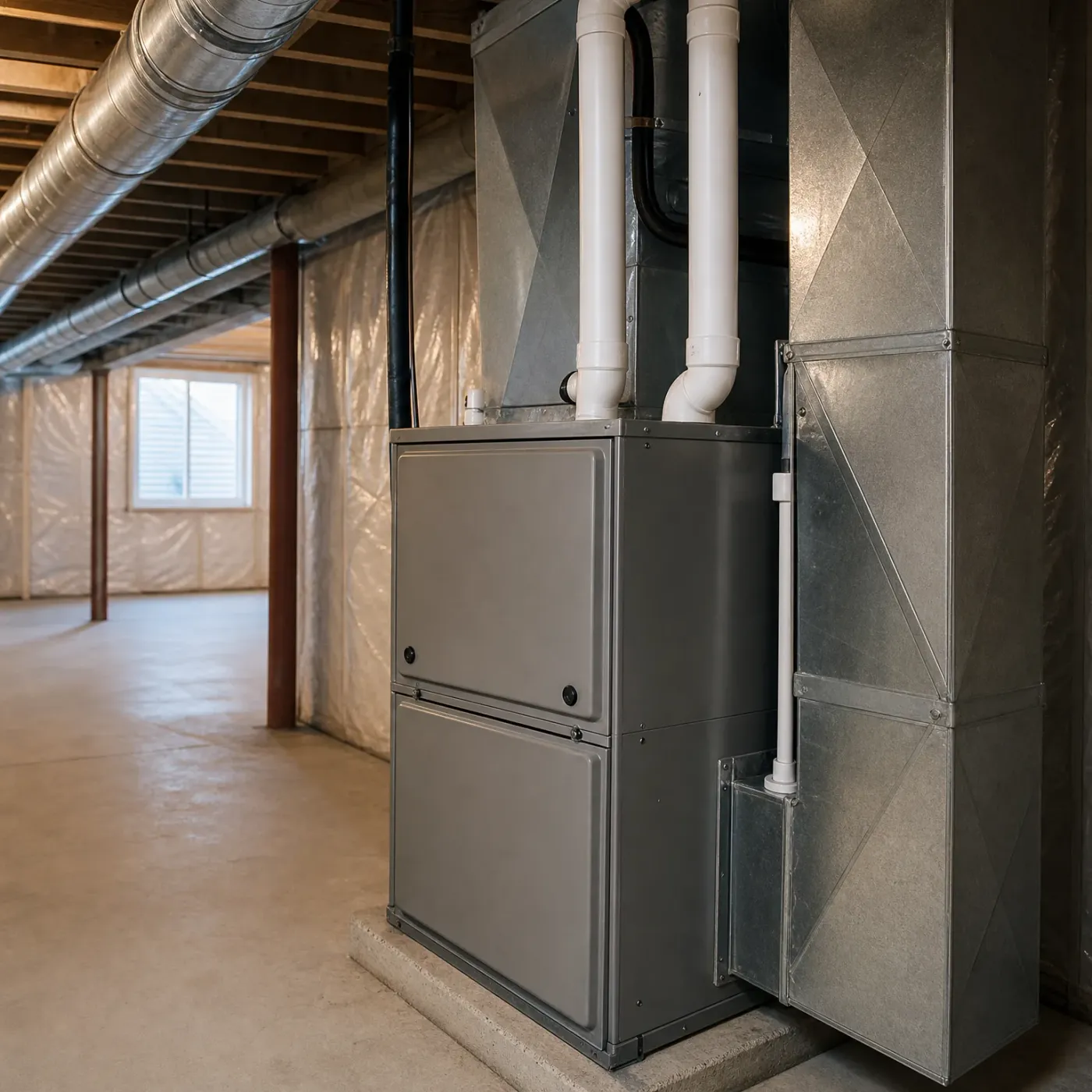
A gray high-efficiency furnace in a basement with white PVC vent pipes, sheet-metal ductwork, copper and black piping, a condensate pump, and insulated walls above a concrete floor.

Running the way it should

This is a furnace holding its temperature without a fight. The ductwork is sized right, the condensate line drains clean, and the burner only has to reach the setting you gave it. A system like this answers a thermostat change in minutes, not hours.

A beige residential furnace stands on a concrete basement floor beside galvanized sheet-metal ductwork, a round flue pipe, copper gas piping, and a PVC condensate line, with a wood-paneled wall at right.

Working harder than it should

Age shows here before a breakdown does. Light grime on the cabinet, an older flue, panels that have been off more than once. A furnace in this shape can still heat the house, but it leans on longer burner cycles to get there, and that shows up on the gas bill before it shows up as a repair call.

Hold Steady or Set It Back

Set it and leave it

  • Picking one number for the day and holding it there means the furnace cycles on and off in short, predictable bursts instead of working to recover a big swing.
  • The burner only has to make up for whatever heat the house loses through the walls and windows since the last cycle, not catch up from a cold start.
  • You know exactly what the house will feel like walking in the door, no guessing based on what time you left or how cold it got while you were out.
  • A steady setting is easier to notice when something's off. If the furnace is running longer than it used to just to hold the same number, that's worth a look.

Dialing it back and up

  • Dropping the temperature overnight or while you're out and bringing it back up later asks the furnace to recover that lost heat all at once.
  • A bigger setback, ten degrees or more, means a longer recovery run when you raise it again, and the burner works harder during that stretch.
  • The furnace has to push more air through the ducts to close a wider gap, which means it runs longer each time it kicks on.
  • A programmable or smart thermostat can handle the timing automatically, so you're not the one remembering to adjust it twice a day.
A man in a gray sweater reclines in a brown leather armchair with his eyes closed, beside a wooden side table holding a mug, a folded newspaper and a potted plant, with a bookshelf and sunlit window behind him.
A man with greying hair and a dark sweater leans back on an armchair with his eyes closed and a slight smile, in a living room with a bookshelf, plant, folded newspaper and mug on a wooden table.
A man in a gray fleece jacket sits reclined in a leather chair with his eyes closed, in a room with bookshelves, a table lamp, a window, and a desk holding a folded newspaper and a dark mug.
A bearded man in a gray fleece pullover sits with eyes closed in a brown leather armchair in a living room, with a floor lamp, bookshelf, potted plants, a side table holding newspapers and a dark mug, and a bright window behind him.
A gray high-efficiency furnace on a concrete pad in an unfinished basement, with white PVC vent pipes, galvanized sheet-metal ductwork, insulated walls and a small window in the background.

Finding a pro stops being your job

A licensed local pro takes the request for your furnace tune-up.

Send the form, and lining up the furnace tune-up stops being yours to chase.

Find a licensed pro

It costs nothing to send, and you don't have to hire anyone.

A gray high-efficiency furnace stands on a concrete basement floor beside galvanized sheet-metal ductwork, white PVC vent pipes, copper and black piping, and unfinished wood stud framing.
A furnace that's keeping up holds the temperature you set and cycles quietly, without long runs or short-cycling to catch up.
A gray furnace with two access panels stands on a concrete basement floor beside sheet-metal ductwork, with pipes, flexible conduit and an electrical box on the concrete wall to the left.
A furnace in trouble runs long to reach the same setting, and a panel left loose or a drain line backing up is often why.

How a furnace actually cycles

  • A furnace fires its burner, then waits for the heat exchanger to warm before the blower kicks on to push air through the ducts.
  • The thermostat reads air temperature near itself, not the heat exchanger, so it calls for heat again once the room cools a degree or two past the setpoint.
  • Every cycle ends with the inducer motor clearing the exhaust before the burner shuts off, which is why you hear a short run after the house feels warm enough.
  • A dirty flame sensor makes the burner shut off seconds after it lights, so the furnace short-cycles instead of running a full heating cycle.
  • Setback thermostats force a longer burner run to recover the lost degrees, which is harder on the igniter than holding one steady number.
  • Low static pressure from a clogged filter makes the blower run longer to push the same amount of air through the ducts.

A furnace doesn't just flip on and match your number right away. The burner fires first, and the heat exchanger has to come up to temperature before the blower switches on, so there's a short lag before you feel warm air. The thermostat only knows the air around it, so it calls for heat again once that spot drops a degree or two below what you set, not the instant it drifts off. Even after the house feels warm enough, you'll hear the furnace keep running a little longer, because the inducer motor has to clear the exhaust before the burner shuts off for good. That's normal.

What isn't normal is a furnace that shuts off seconds after it lights. That usually points to a dirty flame sensor, not the thermostat setting. And if you've been dropping the temperature overnight to save gas, know that the recovery in the morning asks more of the igniter than just holding one number would. Every time the burner has to make up several lost degrees instead of one, it's a longer, harder run.

The filter plays into this too. When it's clogged, static pressure in the ducts climbs, and the blower has to run longer to move the same amount of air through the house. None of this means your setpoint is wrong. It means the number on the thermostat is only half the story. What the furnace does to reach and hold it, cycle after cycle, is the other half, and it's where most of the strain and most of the gas get spent.

Winter nights average 28°F statewide

A 28°F night means your furnace isn't just topping off heat, it's making up real ground between cycles. That's the stretch where a thermostat set too low in the morning asks for a long, hard recovery instead of a quick one.

NOAA nClimDiv 1991-2020 county normals weighted by homes

68°F while you're home, lower while you sleep or when the house is empty, is the number that holds up through a Delaware winter without punishing the gas bill. The rest comes down to whether the furnace can actually hit that number without a long fight. A full filter, a weak igniter, or a drain line backing up turns a normal cycle into a long one, and a long cycle is what shows up on the bill in January. None of that shows itself from the thermostat. It shows up in how the furnace sounds, how long it runs, and whether every room comes up to the same number. A yearly check catches the igniter or the drain line before a cold snap finds it for you. You already know the number to set. What's worth knowing now is whether the furnace behind it is still able to hold it.

A gray-haired man in a blue quarter-zip sweater sits in an armchair with his eyes closed, beside a large window with bare trees outside and a potted plant and lamp nearby.
A woman in a cream knit sweater sits in an armchair with her eyes closed and head tilted back, beside a window showing orange autumn foliage and a wooden side table with a mug.

Let someone else find the pro

A thermostat setting only holds up if the furnace behind it is working the way it should. Yearly maintenance is what catches a cracked heat exchanger, a dirty flame sensor, or a drain line about to back up, before one of those turns into a cold house in January. A licensed Delaware contractor who services furnaces all winter knows what tends to go wrong in homes here and what to check first. Send the request and the search is done. One contractor gets in touch, not five.

Find a local pro

Only one pro gets your request, so you hear from one company.

No charge to send it. You decide if you hire them.