Profile view of a bearded man wearing a black baseball cap and a dark gray T-shirt against a plain light background.

Why your furnace keeps turning on and off in Delaware

Step 1 of 3: Equipment

Why does my furnace keep turning on and off?

It's doing this during a cold stretch, cycling on for a few minutes then shutting off before the house feels warm. With gas heat running hard through a Delaware winter and power costs what they are, that pattern either means wasted money or an early warning of something that's going to leave you without heat.

Usually a dirty filter or a flame sensor that needs cleaning

A furnace that shuts off early is almost always overheating and shutting itself down to protect the heat exchanger. A clogged filter cuts off airflow, the burners keep firing, and the inside of the furnace gets hotter than it should until a safety switch trips it off. A dirty flame sensor causes the same kind of short cycling, telling the control board the flame isn't there when it is, so the burners shut down almost as soon as they start. Both get worse the longer a furnace runs through a Delaware winter. A furnace doing this on a day in the teens or 20s is working harder for less heat, and the part causing it rarely fixes itself.

A beige residential gas furnace with white PVC vent pipes, copper and yellow gas lines, and adjacent sheet-metal ductwork stands on a concrete floor beside a plain white wall.

What short cycling does to a furnace

A gas furnace that fires up and shuts off repeatedly puts more wear on the igniter and the blower motor than one that runs a full cycle and stops. Each start draws more power than running steady does, and in a Delaware winter a furnace might fire a dozen times an hour instead of two or three. That adds up on a power bill that's already not cheap, and it shortens the life of parts that aren't built for that many starts.

A gray high-efficiency furnace with white PVC vent pipes and metal ductwork stands on a concrete floor beside a plain off-white wall in a basement.

A dirty flame sensor is often the cause

The flame sensor is a thin metal rod near the burners that tells the furnace a flame is actually lit. A layer of soot on it can make the furnace think the flame went out seconds after it started, so it shuts the gas valve and tries again. It's a small part and cheap to clean or replace, but a furnace can't tell the difference between a dirty sensor and a real safety problem, so it shuts down either way.

Is this what's happening in your house right now

You hear the burner kick on, feel a little warm air from the vents, then it shuts off again before any room actually warms up. A few minutes later it starts back up. Some houses get a mild burning smell when it fires, or a clicking sound from the cabinet right before ignition. The thermostat might show the set temperature never getting reached, even though the furnace keeps trying. Your gas bill can climb even though the house doesn't feel any warmer, since you're paying for all those extra ignitions. Left alone through a Delaware winter, that repeated strain on the igniter and blower motor is how a furnace ends up failing on the coldest night instead of a mild one.

A smiling man in a gray long-sleeved shirt stands in a kitchen looking to the side, with open shelves of dishes, a white mug on the counter, a potted plant, and a view through a doorway into a living room.
A smiling bearded man in a green sweater sits at a white marble kitchen island with a mug, potted plant and bowl of fruit, in a bright white interior with open shelving and an arched doorway.
A smiling man with dark curly hair and a beard, wearing a dark green knit sweater, stands at a white marble kitchen counter with a dark blue mug, with open shelving, pendant lights and a houseplant behind him.
A smiling man in a green ribbed sweater stands behind a wooden table holding a ceramic mug of coffee in a kitchen with white subway tile, shelves of potted plants, and a bowl of fruit.

Filter Fix or Failing Part

Dirty filter

  • A clogged filter cuts off airflow across the heat exchanger, and the furnace trips its limit switch to keep that part from overheating.
  • This usually shows up gradually, so the cycling gets worse over a few weeks rather than starting all at once.
  • Swapping the filter is something you can do yourself, and it costs far less than a service call if it clears things up.
  • If the cycling stops right after a filter change, that was the whole problem and nothing else needs attention.

Failing part

  • A cracked flame sensor, a bad limit switch, or a blower motor pulling more current than it should will all cause the same on-off pattern.
  • These don't resolve with a filter swap or a reset, and the cycling will return within the same heating run or the next one.
  • A furnace that keeps restarting to compensate for a failing part is drawing more power each time it fires, which shows up on the bill given Delaware's electric rates.
  • Left alone, the part that's struggling usually fails the rest of the way, often during the next cold snap when the furnace is running hardest.
  • A technician can test the sensor, the switch, and the motor directly and tell you which one is causing it rather than guessing from symptoms.
A basement utility area with a gray furnace, sheet-metal ductwork, pipes, plastic-covered walls, a concrete floor, and a black shelving unit holding storage bins.

Running the way it should

A furnace that's cycling normally fires up, runs long enough to push warm air through every vent, and shuts off once the thermostat is satisfied. The burner stays lit for several minutes at a stretch, not seconds, and the blower keeps moving air the whole time.


A gray metal furnace with louvered vent panels stands on a concrete basement floor beside galvanized ductwork, gas and plastic pipes, and foil-faced insulation along the ceiling and wall.

Rust, age, and a pattern that's gotten worse

An older furnace like this one has had more chances for a cracked heat exchanger, a failing flame sensor, or a limit switch that trips early. Surface rust on the cabinet doesn't cause short cycling by itself, but it's a sign of a unit that's been working through a lot of Delaware winters already.

A smiling man with dark curly hair in a navy t-shirt sits on a gray couch indoors, with a large-leafed plant and a window in the background.
A bearded man in a plaid flannel shirt stands in a kitchen looking out a window toward snow-covered shrubs, with a steaming mug on the windowsill and potted plants on a shelf behind him.

Let someone else find the pro

A furnace that won't settle into a steady run isn't going to fix itself by morning, and every short cycle in the meantime is another hard start on the igniter and blower, another jump in power draw during a stretch when Delaware electric rates already sting. Figuring out whether it's a clogged filter, a bad limit switch, or something in the heat exchanger means someone has to actually look at the unit. Left on your own, that's calling a few HVAC companies, explaining the on-off pattern to each one, waiting on callbacks, then weighing quotes against each other while the house keeps cycling cold to warm to cold. Sending this request means you skip that part. One contractor who works on furnaces like yours gets your information and reaches out, and from there it's their job to find what's tripping the limit switch or wearing out the igniter, not yours to keep tracking down. You still have a furnace that needs looking at tonight, but you're not the one doing the legwork to get there.

What's actually causing the cycling

  • A furnace controlled by a thermostat with a loose or dusty sensor can misread room temperature and shut the burner off early.
  • The flame sensor, a thin metal rod in the burner path, reads the flame itself and cuts gas if it can't confirm a steady fire.
  • A flame sensor coated in carbon reads weak even when the burner is working fine, so the control board shuts things down out of caution.
  • An oversized furnace heats the air near the thermostat fast, satisfies it, and shuts off before the rest of the house catches up.
  • Return air blocked by a closed vent or furniture starves the blower, and the pressure switch stops the burner to protect the heat exchanger.
  • A cracked or failing igniter can light the burner weakly enough that the flame sensor still cuts it off within seconds.

A furnace needs a few things to line up before it lights and stays lit, and short cycling means one of them isn't holding. Start with the thermostat. Dust on the sensor or a loose mount on the wall can make it read a room temperature that isn't real, so it tells the burner to shut off before the house has actually warmed. The flame sensor is a different problem. It's a thin metal rod sitting right in the burner path, and its only job is confirming there's a real flame. Carbon buildup on that rod is common, and it makes a strong flame read as weak, so the control board cuts gas out of caution even though nothing is actually wrong with the fire. An igniter that's cracked or wearing out can light the burner just weakly enough that the flame sensor doesn't trust what it sees and shuts it down within seconds. Airflow matters too. A return vent blocked by a closed register or a piece of furniture starves the blower, and the pressure switch will stop the burner rather than let the heat exchanger overheat. And sometimes the furnace itself is the mismatch: one sized too large for the house heats the air right around the thermostat fast, satisfies it, and shuts off while the rest of the rooms are still cold.

A gray furnace with white PVC vent pipes stands beside sheet-metal ductwork in a basement with a smooth concrete floor, exposed wood framing, and plastic sheeting on the walls.
This furnace runs the way it should: the burner stays lit, warm air reaches every room, and it shuts off once because the house is actually warm, not because a sensor misfired.
A beige furnace with two access panels stands against a concrete basement wall, with galvanized sheet-metal ductwork, a white PVC pipe, flexible conduit and insulated ducting around it.
Rust on the cabinet and worn piping like this often go along with a limit switch or flame sensor that's started failing, which is what turns a normal cycle into a short one.
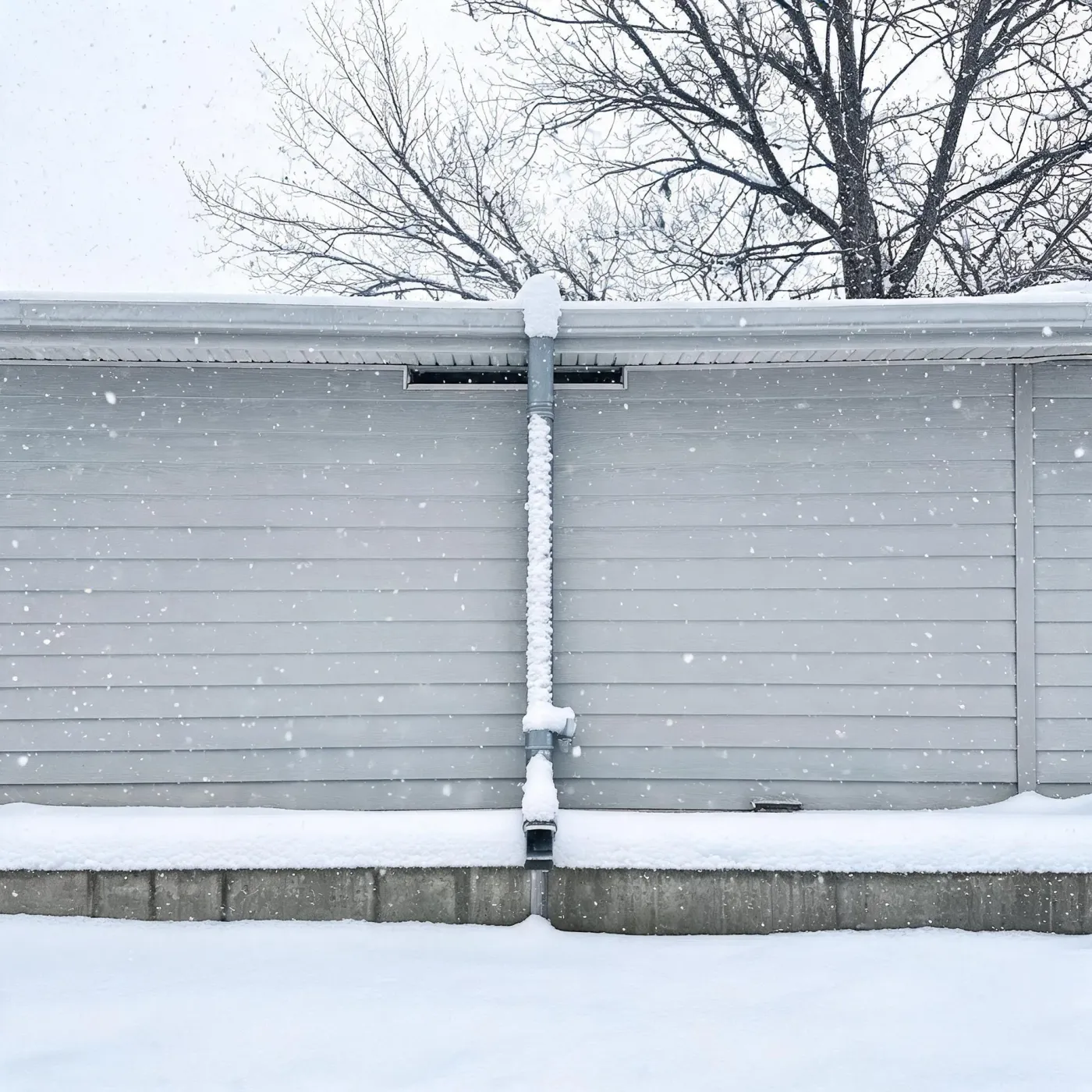
Exterior wall of a building with light gray horizontal siding and a snow-covered downspout running down its center, with bare trees behind the roofline and falling snow over deep snow on the ground.

Statewide, winter nights average 28°F, according to NOAA climate data. That's below freezing most nights from December through February, and it's the stretch when a furnace that's already struggling with short cycling gets worse instead of better. Colder air coming in means the burner has to fire more often just to hold the thermostat setting, so if yours is already shutting off early, you'll notice the cycles bunch up tighter on those nights, every twenty minutes instead of every hour. Rooms farthest from the furnace will feel the gap first, staying cool even with the vents blowing. The harder the furnace works to keep up, the more those short cycles add up on the parts taking the strain.

NOAA nClimDiv 1991-2020 county normals weighted by homes

A gas furnace with a louvered upper panel stands on a concrete pad in a basement, flanked by sheet-metal ductwork, white PVC and metal pipes, and insulated columns.
Before you get your furnace repair
A dark high-efficiency furnace on a concrete pad in a basement, connected to galvanized ductwork, white PVC vent pipes, and copper and black gas piping, with concrete walls and wood framing nearby.
After you get your furnace repair

Living with it for now

You can keep bumping the thermostat and resetting the furnace when it stalls out, working around a cold room here or there until the weather breaks. It buys time, and plenty of people do it for a week or two. But every short cycle in the meantime is another hard start on the igniter and blower, and another spike on a power bill that's already high in Delaware. The furnace doesn't fix itself between now and spring, and most short cycling problems get worse over the following weeks, not better, especially once nights settle in below freezing.

Getting it looked at

Once you send the form, you're done hunting for a contractor, calling around, and explaining the same problem three times to three different companies. A licensed contractor gets matched to you and takes it from there, checking the flame sensor, the filter, the limit switch and whatever else is making the burner cut out early. You're not stuck comparing quotes or waiting on hold. The part that's gone is the legwork of finding someone to look at it, not the work itself, but that's usually the part that keeps people putting it off.

Winter nights average 28°F statewide

A 28°F night means your furnace is running long stretches to hold the thermostat setting, not short bursts. If yours is shutting off after a few minutes instead, it's fighting the cold rather than keeping up with it.

NOAA nClimDiv 1991-2020 county normals weighted by homes

A furnace that keeps turning on and off before the house warms up has a reason for it, whether that's a dirty filter choking off airflow, a flame sensor that can't hold a steady read, or a limit switch doing exactly what it's built to do when something upstream is wrong. None of those get better with time, and none of them are things you can see for certain just by watching the burner cycle. What changes once you send the form is that the work of sorting that out stops being yours. You're not calling around Delaware looking for someone with an open slot, not explaining the same cycling pattern three separate times to three separate companies, not trying to weigh quotes against each other with no way to tell which diagnosis is right. That part ends. A licensed contractor takes it from here, and the house stops losing heat to a furnace that won't settle into a run.

A dark wood cabinet with a paneled door and a ceramic pot of green foliage on top stands in a beige-walled room with white baseboard, a window at left, hardwood floor, and a patterned area rug.
A dark wood glass-front cabinet holding folded towels, woven baskets and a ceramic vase stands in a bathroom corner beside a window, with a potted fern and stacked towels on top and a freestanding tub partly visible at left.
A woven basket holding a green cushion and a cream fringed knit throw sits on a wood floor in a room corner beside a window and a dark wooden cabinet.
Corner of a room with a dark wood cabinet topped by a round vase, a linen curtain at a window, white baseboard, oak plank flooring with sunlight patches, and a woven jute rug in the foreground.
A dark wood sideboard against a pale wall holds a shallow stone bowl and a round ceramic vase with leafy branches, with sunlight from a curtained window falling across the wall, wood floor and woven rug.

One request and it's handed off

Describe your furnace job once, to one pro.

Hand it over

There's no charge for the request.